As 2025 draws to a close, we are waiting to see what new advances in AI the new year will bring, and how these will impact our industry (and web design as a whole). If this year is anything to go by, the speed and rate at which AI is advancing makes us feel that its ability to revolutionise how we work is almost limitless.
It’s increasingly becoming something that we are using, being affected by, or seeing it being used by clients every day; and we’re in no doubt that this will increase in the year ahead.
Testing, experimenting and creating with AI are becoming a standard part of most design work-flows, as this technology has opened the doors for creative expression to be quickly unleashed by anyone, even people without traditional design training.
This new wave has already significantly impacted web design and development, and will continue to impact design trends and processes in these fields, which we believe will see even bigger changes in 2026. In this article, we’ll cover our expectations on what is to come, based on what we have already seen, what others are predicting, and how we think these trends will develop in the near future.
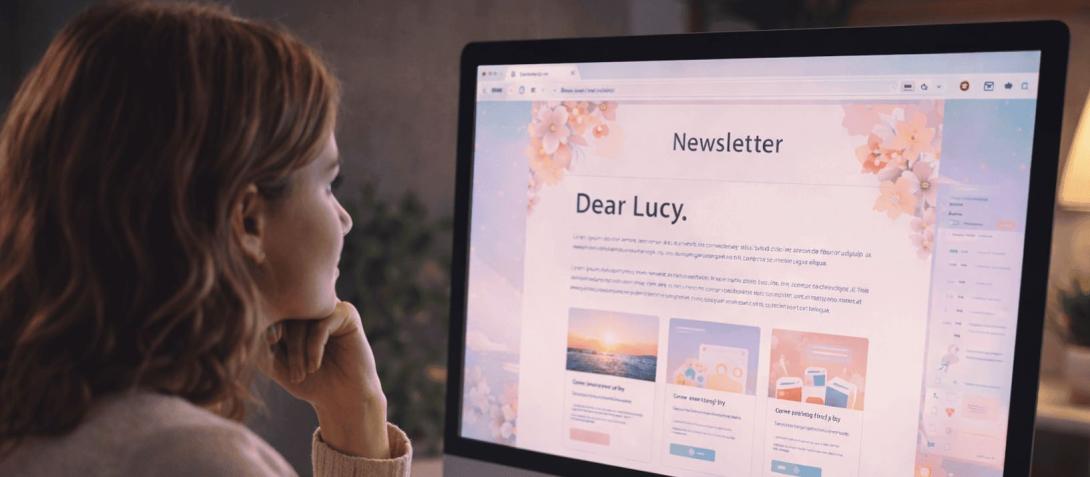
Image created using ChatGPT.
1. Personalisation
Personalisation is already a big thing in the digital marketing landscape and in some cases it has become an expectation from users. The more you can make a user feel as if the content or experience they are being given is designed specifically for them, the more likely they are to engage with your business for longer, and ultimately to use your services or buy your products.
A basic form of website personalisation has already existed for around 15 years in the form of responsive design - any modern website will respond to the user’s device by changing what it displays and where, to better fit the dimensions of the screen the user is viewing.
Web users who have become accustomed to getting a more tailored search experience almost immediately via AI search will be looking for a more advanced web-browsing experience too. That is where we think that adaptive web design will play an increasingly important part.
Adaptive web design uses on-site signals in order to consider the content, layout and experience a user may be served. Analysing whether the user is a first-time or returning visitor, their click patterns, the traffic source they have come from, and even their location and time, can allow an AI-powered website to deliver an optimised experience based on those and similar factors. This builds on what larger websites and Ad networks have been doing for some time.
2. AI as an assistant designer
The question of whether it is ethical to use AI for design or in the design process is still a divisive one, with differing views across the industry. That said, the speed and capabilities of these platforms make it possible to use AI as a tool to support or speed up design and development work while still keeping a person in the loop, helping to ensure that personal knowledge, experience and human instincts are still involved in design. This usage is only likely to grow in 2026, and will pose many challenges in the industry - we think it may particularly affect people that are starting out in design, or anyone without a distinctive artistic style or a personal brand that helps drive demand for their work.
Google Gemini’s Nano Banana Pro now offers high-quality creative expression with a single short prompt and is able to bring ideas alive in just seconds, without the need for a series of mock-ups and potentially hours of work and feedback.
This option may well appeal to smaller businesses, or those without budgets for design, as the initial brainstorming and idea generation can be done in such a short space of time. Agencies are utilising AI for idea creation and as a jumping-off point that can create results in minutes, freeing up time for designers to consider the refinement, details and deeper user experience. It looks to us as though the future will be one where designers are working collaboratively with AI, using that to enable their creativity and explore multiple paths in a shorter period of time. Something may also be lost with this new process, but it now seems inevitable.
AI impacts not only design but development, with vibe coding being named as Collins Dictionary’s Word of the Year, a sign of how normalised this has become. If you haven’t already heard of it, vibe coding is essentially the process of using AI to produce and write code for a website or app or other system, mainly by using AI prompts. This opens up the development process to anyone who has the desire to create a website or app, without requiring the skills and training to write or debug code.
Ethical considerations again come into play here, along with the potential security risks and flaws that may be hidden in the generated code. Without the software developer's knowledge and experience, honed over years of writing, assessing and debugging code, you are less likely to be able to identify structural problems or bugs - so at least for know the human developer still has a key role to play.
Web developers now have the option to use AI to speed up writing code for web pages as well as web applications and complex systems, and to help test and review their own draft code. To some extent this simply builds on the 'website creation' systems (such as Wix and Squarespace) and 'zero code' platforms that have existed for many years - but it is a step change, as even zero code platforms required a greater degree of experience and knowledge to program than simply writing a prompt.
We believe that in 2026, the use of AI as a design and coding assistant will continue to help agency teams to reduce costs and supercharge their workflows, as well as democratising design and coding by making it possible for more and more people to do both. That may just be speeding up existing trends towards more systems that allow anyone to create a website, but it also feels like a very significant change to the web design industry.

Image created using ChatGPT.
3. Conversational tone
Optimising for AI search will be something that is considered in more and more cases for website content and copy in 2026. With traditional organic search figures trending downwards for non-brand searches because of AI search results in Google and other search engines, and the use of tools like Chat GPT and Perplexity growing as a substitue for search engines, businesses are having to consider what they can do to optimise their websites for these new platforms in order to maintain or grow visibility.
This conversational style of language that is preferred by AI search is set to dominate web copy in the new year, with more and more businesses tweaking their tone and re-evaluating text content on their websites based on how AI search will view it, in the hope of being cited in answer engines and within AI overviews.
Deeper brand storytelling with emphasis on purpose and meaning is also likely to be front and centre in terms of building out points of difference, and highlighting trust signals for AI, as businesses compete for this form of search exposure.
4. Organic, nature-inspired design
Pantone recently released their colour of the year as Cloud Dancer, which they describe as ‘a lofty white that serves as a symbol of calming influence in a society rediscovering the value of quiet reflection’.
Our next trend seems to echo this and the feeling of society as a whole. It represents a move away from the always-switched-on feeling we know and live by, as created by technology, towards the craving of a calmer, lighter feeling that allows for space and clarity.
Nature-inspired design, softer tones and curves will guide the design industry in 2026 as it aims to offer some peace and connection to what is around us, rather than the intensity and urgency in so much of what we view on a screen.
In a bid to counter the increasing pull of AI and technology, users are likely to value the human touch in their online experiences and particularly seek this out. This calmer, warm, less intense desired feeling will filter through to website UX, with users wanting that same environment to continue as they browse and carry out the functions they need to online.
This type of design feels as if it goes hand in hand with personalisation in truly thinking about how the user experiences your site.
Reflect on the feeling created by your website. With user journeys shortening due to a higher level of focused intent from AI search traffic, you have just one chance after a user lands on your site to make them feel at ease. First impressions are everything.
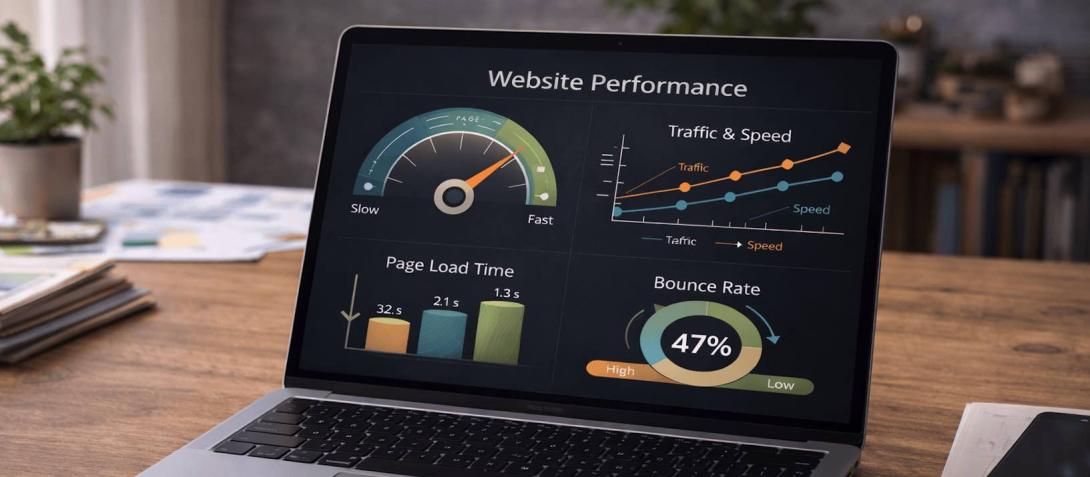
Image created using ChatGPT.
5. Design with performance in mind
Website performance and speed has become a defining attribute of the success of your website. Not only do people not have the time or the patience to wait for slow-loading pages, reflected in how search engines rank your pages, but AI search doesn’t either.
Page speed and load times are a key element AI search assesses when reviewing content and websites in search of those all-important citations.
Designing with performance in mind is becoming the new norm for web designers, who previously may have focussed more on the beautiful animations and interactivity that it is possible to build into pages with theming systems like Elementor in WordPress. They will now be trying to balance a beautiful, functional design with a site that delivers on-page speed to satisfy not only human users but also AI crawlers. This incorporates and builds on the trend towards faster leaner websites ('low carbon websites') seen in recent years.
We think it’s generally a win-win designing to this brief as it will tend to improve the users’ experience of a site overall.
This type of design, without lots of large images and unnecessary animation, supports the ability of the user quickly and easily to find what they are looking for. Human users will generally appreciate a clean design that easily offers up the information they need.
And, with the potential for more higher-intent customers landing on websites directly from AI citations and links, customers will expect the journey they need to take to purchase or services to be immediately obvious rather than having to figure this out by exploring multiple pages.
Designing with speed in mind from the outset ensures the basic structure of the website can deliver the loading times required and reduces the need to do additional work later to improve page load speeds.
To review the speed of an existing website, you can try using Google’s PageSpeed Insights which will make suggestions as to where improvements can be made. Improvements can include optimising (compressing) any images, checking that all code is clean and compressed, securing reliable and high-quality hosting and (with WordPress) reviewing the number of plug-ins and widgets your site uses and removing any that are not in use.
Conclusion
One thing is clear: we’re excited about what web design and development will look like in 2026, and the challenges that we will be overcoming.
There is no doubt that many website projects are moving faster (on tighter budgets) with the increased efficiency that AI is enabling; and design creation has a limitless feel with the latest batch of AI tools that has entered the market.
One key theme in all the trends we have mentioned is thinking about how you can deliver the highest-quality user experience in a human-centric way.
It's great to optimise for AI search and ensure all of those boxes are ticked, but at the end of the day it is humans that will actually be taking the actions on your site (for the time being), so try to ensure their needs and expectations are met.
These predictions are based on our own experience, current industry trends that are reflected in what people are writing about, and things that we have directly observed. We plan to review this article in a year’s time to see which of the trends we forecast here have continued, which have petered out, and any new ones.
If you would like to discuss any of the trends mentioned or an idea for your website, please get in touch – one of the team would be happy to help!
Please note our banner image for this article was created in ChatGPT.