The short answer to the question about whether or not SEO is dead is that SEO (Search Engine Optimisation) is far from dead, but has been changing, and will continue to evolve, as it always has done. It is a question we often see being asked in many places, and every time so far it has adapted to the prevailing changes with Google, and with other sources of traffic. With hindsight we can see that the core principles of SEO and what that means have remained the same, but the strategies and models used have had to develop.
But isn’t it different this time with AI?
The advent of AI search has certainly reduced organic clicks from traditional search engines, and we are currently seeing more zero-click searches than ever before, but Google does still lead discovery, processing about 14 billion searches a day, an order of magnitude greater than the number processed by chatbot facilities such as ChatGPT, which currently processes around 66 million prompts per day.
AI referral traffic represents just over 1% of total web visits at the time of writing, so those thinking about throwing away their SEO playbook and investing all their efforts into AI search need to take a deep breath, stand back a little from the current hype and noise, and assess exactly how they can adapt their current workflows to cope with both.
AI search is certainly growing, and should not be ignored by businesses (it is something that should be built into current and future marketing plans), but it is not a case of having to abandon SEO for AEO (Answer Engine Optimisation) or GEO (Generative Engine Optimisation).
It is more a question of how businesses can optimise their websites for both search engines and answer engines, and explore how these two channels can complement each other, as there is a lot of cross-over in the steps used for the optimisation practices related to both types.
These considerations also tie in with keeping in mind the power of marketing to build your brand – brands have never gone away, and brand awareness and brand searches are becoming even more important to standing out in the AI-mediated online world.

Image created using ChatGPT.
How AI search has changed traditional search
AI search, as facilitated by the likes of ChatGPT, Google Gemini and AI Overviews, has changed how we discover information and suppliers. Discovery is no longer happening via searching for keywords, with the traditional model of seeing the top ten-ranking results for your query and then clicking through to one or more of those links. High online visibility is no longer as simple as achieving a ranking at the top of Google search for the relevant keyword combinations.
The search ecosystem of the past has been replaced in many cases by users navigating directly to a preferred answer engine (sometimes Google), typing out their query or prompt, and being served a refined, precise answer or AI-generated overview that answers their query. Users who receive answers within AI search may leave it at that, in which case they are a ‘zero click’ search as they will not interact with another website. But while that is increasingly common, some of them will go on to explore further by navigating to websites and brands that have been mentioned and cited within the answers they have received, in order to fact-check or to see the same information as presented by its original source, rather than the interpretation offered by the answer engine. Initial discovery is now happening within AI search tools, which is why you need to consider how to make AI search visibility part of your current strategy.
Rather than first impressions being made when users land on the home page of your website following discovery in Google or another search engine, first impressions are now being formed based on the information that users have received from an AI search platform or answer. Brand consistency across platforms is important in order to gain trust from users who are likely to be fact-checking information they have found in AI search about your business on your website, and quickly locate third-party views of your strengths and weaknesses.
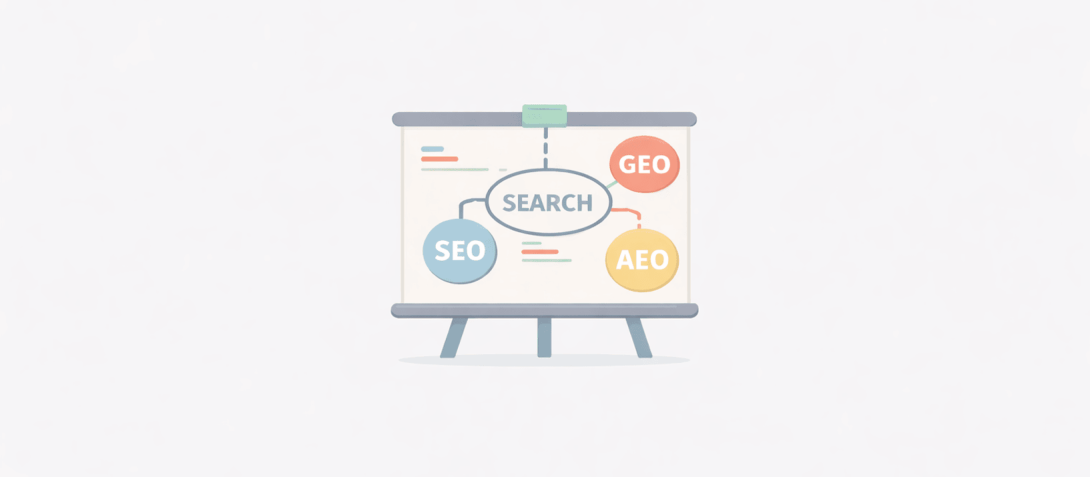
Image created using ChatGPT.
SEO vs AEO and GEO
Optimising for AEO or GEO is not hugely different from many of the practices you have already been following in order to optimise for SEO.
Featuring content that will specifically support your business in showing up as a direct answer within search, such as a snippet or a voice assistant response, is still fundamentally creating content with the specific goal of being cited or mentioned by those systems, just as content was created with Google in mind in the past.
AI search favours unique, authoritative content that offers human experience and expertise: real, informative content that is useful for the user. Assuming that such content has been the base of your existing SEO strategy, your business should be well-placed to gain reasonable visibility within AI search with relevant prompts.
There are also other factors AI answer engines generally favour, such as:
- FAQs and similar question and answer formats
- Bulleted and numbered lists
- Technical page structure
- Schema markup
- Page speed
- Multimodal content
- Brand reputation and reviews
Many of these are relevant to SEO too. It’s important to take all these points into consideration, and to review content, structure and reputation and manage them accordingly. Businesses should continue to optimise their content and base their strategies on offering the best, highest-quality experience for their users, while remembering the requirements of popular search engines and AI tools. This is the ideal approach to SEO, AEO and GEO – if you do things specifically just for those engines, then that can result in your website being over-optimised.

Image created using ChatGPT.
Futureproofing for search
There is much discussion of how to ’futureproof’ for search. This basically means being flexible and adaptable when it comes to changing strategies. As much as the hype around AI search would lead you to believe that SEO is becoming obsolete, it isn’t. The model and the purpose it serves is just changing.
The focus will no longer be only on traffic acquisition: it will be about maintaining and monitoring brand reputation to ensure that when an answer engine or search engine generates a response in reply to a query or prompt, it will be your business that it is shown via mentions and citations because of the positive signals the answer engine has been able to find.
Creating these overarching, cross-platform positive signals in relation to your business and brand is what you should be aiming for and incorporating into your ongoing strategy, along with ensuring you adhere to the traditional SEO best-practice.
SEO is far from dead, but looked at broadly, it has to reflect the changing face of online search and the use of AI chatbots. We have no doubt that this question will continue being asked, but we are confident that for websites in 2026, focusing on the combination of SEO, AEO and GEO while keeping the quality of the overall user experience in mind is a sensible strategy to protect and grow your online visibility.
Please note our banner image for this article was created using ChatGPT.
If you would like more information on our services, or have any thoughts on this article you would like to share, please send us a message.