The rise of Large Language Models (LLMs), Artificial Intelligence (AI) answer engines and AI overviews has had a dramatic impact on organic search results for many websites. The general consensus is that around 60-70% of organic traffic has been lost to 'zero-click' searches, where searches are being served an immediate answer within an AI overview or by an AI answer engine, so there is no need for the user to click through to another website. We have in some cases seen drops of around 50% in organic traffic in the years since ChatGPT exploded onto the scene, followed by many other LLM competitors. The question, if sites are losing this amount of organic traffic when they are following best practice and Google's webmaster guidelines, is how can we maintain visibility and authority within search, and how best to replace that lost traffic?
The impact of AI answers on web traffic within a relatively short space of time has left businesses with web presences trying various different approaches - for example, attempting to target AI traffic with optimisation for answer engines, trying pay-per-click campaigns in search and social media, and attempting to use AI to produce content faster and in larger quantities, to help make up for the lost traffic in other areas. All these approaches are challenging in terms of getting a decent rate of return on the investment, and the use of AI for content generation is being penalised by Google.
It currently feels as though the web marketing industry is still adapting to the effects of the AI revolution, and in many cases searching for a magic bullet to restore pre-AI traffic levels. With a whole new marketing landscape to navigate, one that changes daily, it can be hard for businesses to know where to focus their efforts in order to make a real, measurable positive difference.
One interesting trend that has been remarked on by marketing experts is that, while we are seeing a definite decline in visits from organic search, and in particular from research-related phrases, visits from branded searches have been very consistent and are often growing. These are searches that include a specific brand / company name. They are therefore coming from users who are already familiar with the business concerned, or have seen it mentioned or recommended in another context. These searches also come with the major advantage that they are pre-qualified, and so much more likely to convert to an enquiry or order, since the person already has a particular company in mind.
What this means is that although answer engines and AI overviews are taking traffic for research-related phrases, and generally doing a good job of answering many questions, branded searches are still delivering well-qualified visitors to websites at the same rate they did before AI became so ubiquitous.
Arguably more than at any previous time since the internet was launched, it is now time for businesses to widen their marketing focus and embrace a multi-faceted approach that will allow them to boost their business and brand across different touch points - and meet potential customers where they spend time, across various different platforms and websites - rather than primarily relying on capturing traffic from search.
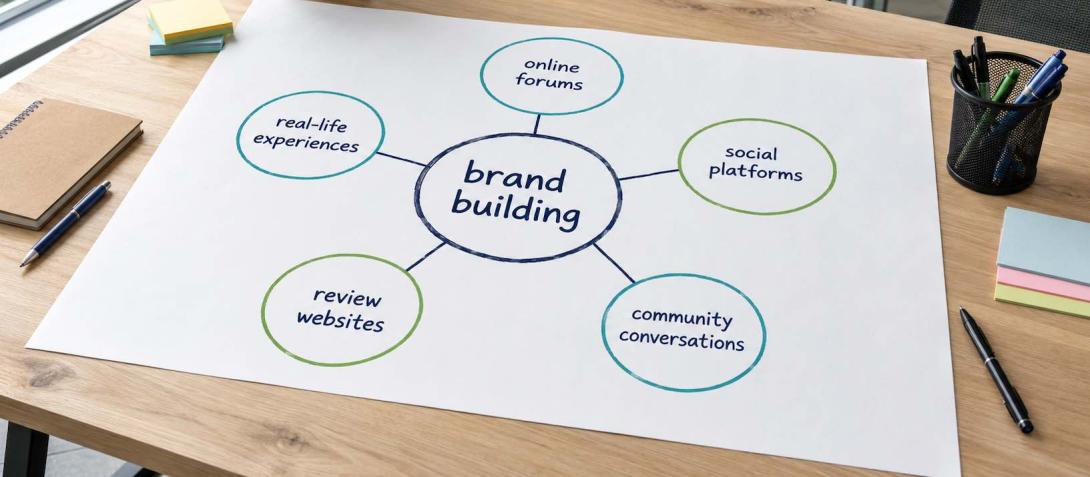
Image created using ChatGPT.
What is brand-building?
Brand-building is a way of increasing awareness of your brand or business within your targeted customer base. It is how you tell the story of your business to your customers and the wider public. For example, what is the purpose of your business and by what values does your business operate?
Brand-building includes how you portray the business across all the platforms and touch-points through which your potential customers come into contact with you.
It is a discipline that has been hugely affected by the internet since the late 1990s, and now we have transitioned from customers initially hearing about a business through a radio or print-based publication or flyer or TV advert, to having their first experience of a business via reading about it on a website, perhaps in an online forum, such as Reddit (a site that is having a moment currently - please see our recent article The Rise of Reddit to find out more), or within a community on a social networking platform, such as LinkedIn.
Potential customers now seek more evidence of reliability and quality, and want to hear first-hand experiences of businesses from other customers - something known as 'social proof'.
The fundamentals of brand-building
Establish an Identity
Your identity will define your business. Establish what this is, including the values the business will uphold and the core purpose of the business. This will offer a starting point and a framework upon which to base all future business decisions.
Your identity can, for example, be based on what problem within the market you will solve and how you will do so. This will be your proposition to customers and the reason for the business / organisation to exist.
Define your niche
Once you have a core identity for the business and a solid proposition to offer, you need to determine your niche. How will the business be positioned within the market and how will it differentiate itself from the competition? Unless your proposition is completely unique and new, it is likely that you will be entering a market in which competition already exists and is established. Researching this competition and assessing how your business will differ and attract customers is vital for the success of the business and to stand out in marketing terms. Think about how you can improve upon what the competition has to offer for the customer, be that in terms of quality of product, service or better value for money. A customer needs to be able to clearly and easily see why they should choose your brand over another.
Consider your ideal audience
Determine your ideal customer or range of customers, considering who and where they are. A useful way to get a full understanding of your ideal customer can be to create a number of personas to describe your perfect customer or types of customer.
Create a full profile for them including gender, age, job, location and interests so you can narrow down exactly how you will appeal to these people.
Next, consider where they are likely to discover your business in the new digital landscape that has emerged. More and more, customers are discovering brands and businesses on community-focused platforms and social media such as Reddit, LinkedIn and TikTok, rather than in locations served by more traditional marketing methods.
With the increase in marketing noise and general mass-produced content that has taken hold since the introduction of AI platforms, it can be hard for customers to differentiate the good from the bad, and to find what they are looking for.
Community conversations, recommendations and real-life experiences of a business or product (for instance on local community WhatsApp groups) are what the typical modern-day customer will be looking for.
Tell your story through omnichannel marketing
Once you have a clear idea of the platforms your customers are likely to be on, the communities they are likely to be a part of and where they spend their time, it is a good to consider how you will reach them across multiple areas.
Research from NP Digtial has shown that Gen Z customers need around 11 touchpoints from a business or brand before acting. This has increased from the traditional value within marketing theory of seven touchpoints.
Customers now expect to see your brand or business mentioned across platforms such as online forum discussions, content creator recommendations, YouTube videos and expert opinions.
Being seen in a positive light across these platforms will build awareness, trust and credibility for your brand with potential customers, making them more likely to reach out to you.
Remember, authentic, real content is leading the way at the moment in terms of persuasiveness. Content does not have to look like a polished, well-edited brand video. It could be a talking heads piece explaining the product and what goes into making it, or even a product demo by staff. Telling the real story of your brand or business is how you can build a connection with potential customers.

Image created using ChatGPT.
Bring that story to life
Bring the brand story to life through your content, in whatever form that takes. What is suitable will vary platform to platform and on your target market; but maintain consistency with a logo, brand colours, visuals and tone of voice that are recognisably yours.
Building a brand style and personality that customers will remember and actively seek out can be a powerful way of differentiating you from competitors that are less memorable.
Our take on brand building
Our take on brand-building best practice is that recent changes in the digital landscape and the shift in routes to brand discovery cannot be ignored - and most businesses should be looking to supplement their other online marketing activities with brand-building.
A multifaceted approach that widens your marketing scope, maintaining high-quality traditional SEO techniques while exploring where else your customers or potential customers may be engaging, gives you a better chance than relying solely on traditional SEO or pay-per-click campaigns.
This will require researching platforms and evaluating their suitability to play a part in building your brand, depending on the nature of your business and the customers you are hoping to find. A B2C product-based business, for example, may be more suited to TikTok videos and creator content, whilst a B2B service-based business looking for senior-decision makers may be more suited to LinkedIn.
Assess your current customer profile, and based on them consider the platforms that potential new customers might be using. Another step can be to look at which platforms your competitors are using - all with a view to getting in front of potential customers wherever they are.
Other measures we are currently recommending to clients are improving trust signals by installing review widgets, author biographies and expert profile pages, through adding schema types to relevant pages. Those help web crawlers understand content more easily, and can also benefit AI search visibility. The more you boost citations within AI overviews and answer engines, the more traffic you are likely to get to your website.
Conclusion
The drop in clicks through to web pages via organic search since the introduction of AI can seem daunting, especially for smaller businesses whose brands are not well-established household names.
The businesses that are most likely to succeed from here onwards are those that are able to evolve and adopt new marketing methods, focussing on platforms outside the ones that have been used in the past, and on building their brand and brand awareness.
It is the businesses that are able to successfully build their brands and nurture communities their customers spend time in that will ultimately have the ability to ride the current economic uncertainty and come out on the other side with a strong reputation and a solid customer base.
If you’d like to discuss your own brand visibility and how this might be improved, please get in touch. Complete our online contact form or call our team on 0117 972 4835. Someone will get back to you within 24 hours.
Please note our banner image for this article was created using ChatGPT.